In a competitive market like Singapore, getting customers to notice your brand is only the first step. The bigger challenge is getting them to remember your brand and choose it again when they need your products or services.
This is where promotional gifts for brand recall can play an important role.
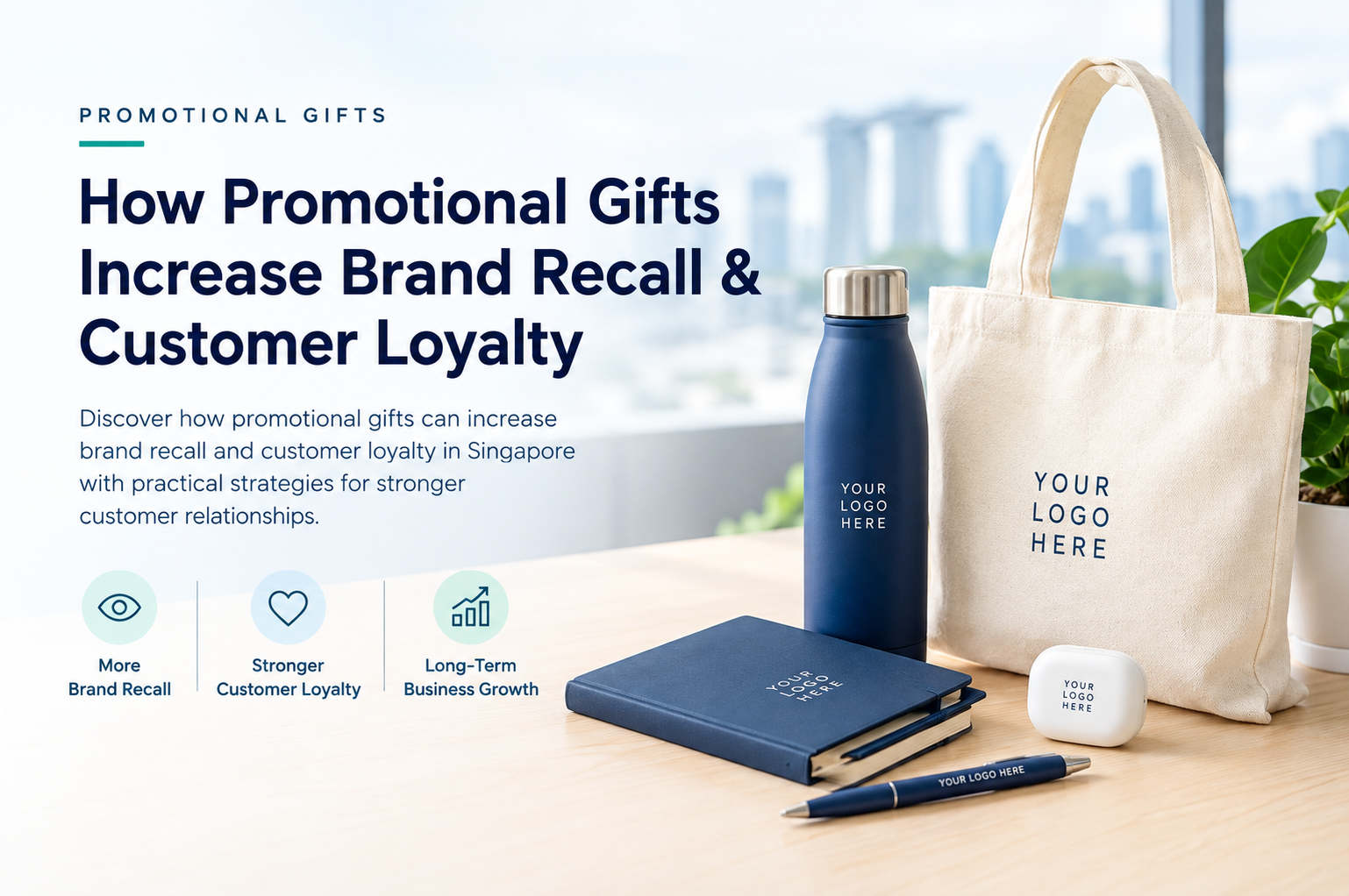
Unlike advertisements that disappear after someone scrolls past them, a useful promotional product can remain in a customer’s daily life for months or even years. A branded tumbler on a desk, a tote bag used during shopping, or a notebook carried into meetings can create repeated opportunities for your brand to be seen.
When these gifts are carefully selected and matched to the right audience, they can support more than brand awareness. They can also strengthen customer relationships, encourage positive brand associations, and contribute to long-term customer loyalty.
In this guide, we’ll look at how promotional gifts can improve brand recall and how Singapore businesses can use them more strategically.
What Is Brand Recall and Why Does It Matter?
Brand recall refers to a customer’s ability to remember a brand when thinking about a particular product, service, or category.
For example, imagine a customer needs a corporate printing service six months after attending your company’s event.
If your brand name immediately comes to mind, you have achieved strong brand recall.
Brand recall matters because customers are exposed to countless businesses every day. Your company may have a good website, attractive advertisements, and strong social media content, but if customers do not remember your brand when they are ready to buy, those marketing efforts may not translate into sales.
Promotional products can help by putting your brand into the customer’s physical environment.
Research from the Promotional Products Association International (PPAI) has found strong levels of brand recall among recipients of promotional products. Its consumer research reported that nine in ten consumers could recall branding on promotional products when prompted.
This suggests that branded merchandise can serve as more than a simple giveaway. It can become another touchpoint between your brand and your customers.
How Promotional Gifts Increase Brand Recall
1. Repeated Brand Exposure
One of the biggest advantages of promotional gifts is repeated exposure.
Consider the difference between these two marketing activities:
Online advertisement
A customer sees your advertisement for a few seconds before continuing to browse.
Branded tumbler
A customer sees your logo every time they use the tumbler at work.
The second option creates repeated physical exposure.
Products such as:
- Tumblers
- Reusable bottles
- Tote bags
- Notebooks
- Backpacks
- Umbrellas
- Laptop bags
- Tech accessories
can continue displaying your company’s branding long after the original event or campaign has ended.
For more practical ideas, see our guide to Top 10 Practical Corporate Gifts Employees Actually Use (Singapore 2026).
The key is not simply putting a logo on a product. The product needs to be useful enough that the recipient actually wants to keep using it.
2. Useful Gifts Create More Opportunities to See Your Brand
A promotional gift that stays in a drawer cannot generate much ongoing brand exposure.
A product that becomes part of someone’s daily routine can.
For example:
At the office
- Tumblers
- Notebooks
- Wireless chargers
- Desk organisers
- Laptop accessories
During commuting
- Tote bags
- Backpacks
- Umbrellas
- Travel mugs
At home
- Drinkware
- Reusable food containers
- Household accessories
- Tech products
The more frequently an item is used, the more opportunities there are for the recipient to interact with your branding.
This is why usefulness is often more important than novelty when choosing promotional gifts.
3. Physical Products Create Longer-Lasting Brand Touchpoints
Digital marketing is essential, but digital content competes for attention with thousands of other messages.
Promotional gifts create a different type of brand interaction because they exist physically in the recipient’s environment.
A customer may not actively think about your company every time they use your branded notebook.
However, the repeated visual exposure can help strengthen familiarity with your brand over time.
PPAI research has also examined promotional products through metrics such as reach, recall, resonance and reaction, highlighting the role branded merchandise can play across different stages of the customer journey.
This makes promotional products particularly useful as a supporting tool alongside digital advertising, social media, email marketing and other customer touchpoints.
How Promotional Gifts Support Customer Loyalty
Brand recall is only part of the picture.
The next step is turning familiarity into a stronger customer relationship.
Promotional gifts can support customer loyalty in several ways.
1. Showing Appreciation
Customers want to feel valued, not simply marketed to.
A thoughtful gift can communicate:
“We appreciate your business.”
This is particularly relevant for:
- Long-term clients
- Repeat customers
- Business partners
- Key accounts
- Referral partners
- VIP customers
For higher-value relationships, a curated gift set may create a stronger experience than a single low-cost promotional item.
You can explore more ideas in our guide to Best Corporate Gift Sets for Client Appreciation in Singapore (2026 Guide).
The goal is not necessarily to give the most expensive gift.
The goal is to choose something that feels appropriate for the relationship.
2. Creating Positive Brand Associations
A useful or thoughtful gift can influence how customers perceive a company.
For example:
A premium tumbler may communicate quality.
An eco-friendly gift may support a company’s sustainability positioning.
A well-designed notebook may create a professional impression.
A personalised gift may make the relationship feel more thoughtful.
The product therefore becomes part of the customer’s experience with your brand.
This is why corporate gifting should be treated as part of your overall branding strategy rather than simply another expense in the marketing budget.
If sustainability is important to your brand, you may also find our guide to Eco-Friendly Corporate Gifts Singapore Companies Are Choosing in 2026 useful.
3. Keeping Your Brand Top of Mind Between Purchases
Customers may only purchase from you occasionally.
For example, a B2B customer may place an order every few months or even once a year.
The challenge is staying relevant between purchases.
Promotional gifts can provide an additional touchpoint during this period.
Imagine a client receives a branded tumbler from your company after completing a major project.
Three months later, they are still using it at work.
Six months later, they need another service that your company provides.
Your brand is already familiar to them.
This does not mean a promotional gift will automatically create a sale. However, it can help maintain familiarity and strengthen the relationship between transactions.
Choosing Promotional Gifts That People Will Remember
Not every promotional product is equally effective.
If your goal is to improve brand recall, consider these five factors.
1. Practicality
Ask yourself:
“Will the recipient actually use this?”
A useful product has a much better chance of staying in someone’s life.
Good examples include:
- Tumblers
- Tote bags
- Notebooks
- Tech accessories
- Umbrellas
- Travel products
- Office accessories
For more ideas, see Top Corporate Gift Categories Companies Are Ordering for Mid-Year Events in Singapore if that article is already published on your site.
Important: If you have not published that exact article/URL, leave this particular link out. The rest of the links in this article are to confirmed published pages.
2. Quality
A cheap product that breaks quickly may create the opposite effect.
Instead of associating your company with quality and professionalism, customers may associate the brand with a poor-quality experience.
You do not necessarily need an expensive product.
Instead, aim for a reasonable balance between:
Product quality + usefulness + budget + branding
3. Visibility
A product can be useful but still provide limited brand exposure if the logo is hidden or difficult to see.
Consider where the branding will appear.
For example:
- Front of a tote bag
- Side of a tumbler
- Cover of a notebook
- Surface of a wireless charger
- Front panel of a pouch
However, avoid making the branding too aggressive.
A clean, professional logo placement can make the product more likely to be used regularly.
4. Relevance to the Audience
The same promotional gift will not work equally well for every customer.
For example:
Office professionals:
Tumblers, notebooks, tech accessories and laptop products
Event attendees:
Tote bags, notebooks, drinkware and practical giveaways
VIP clients:
Premium drinkware, executive stationery and curated gift sets
Employees:
Daily-use products, apparel, wellness items and personalised gifts
Choosing gifts based on the recipient is one of the most important parts of a successful corporate gifting strategy.
5. Personalisation
Personalisation can make an ordinary promotional product feel more meaningful.
Depending on the product, businesses can consider:
- Recipient names
- Company logos
- Department names
- Event names
- Custom packaging
- Special messages
- Company colours
Personalisation is particularly useful for client appreciation, employee recognition and milestone events.
However, not every campaign needs individual names.
For large-scale events, consistent company branding may be more practical and cost-effective.
Promotional Gifts for Different Marketing Objectives
Your choice of gift should start with the marketing objective.
| Marketing Objective | Suitable Promotional Gifts |
|---|---|
| Brand awareness | Tote bags, drinkware, notebooks |
| Customer appreciation | Premium drinkware, gift sets |
| Customer retention | Curated gift sets, useful lifestyle gifts |
| Trade shows | Tote bags, notebooks, tech accessories |
| Product launches | Tech gadgets, premium gifts |
| Employee engagement | Tumblers, apparel, practical gifts |
| Sustainability campaigns | Reusable and eco-friendly products |
| VIP relationship building | Premium corporate gift sets |
If you are planning gifts for exhibitions, our guide to Best Corporate Gifts for Trade Shows & Exhibitions in Singapore provides more ideas for different types of event attendees.
How to Make Promotional Gifts More Effective
Simply giving someone a branded product is not enough.
The way you distribute and present the gift can also influence the overall experience.
Give the Gift at the Right Moment
Timing can make a gift feel more meaningful.
Consider giving promotional gifts during:
- Client anniversaries
- Project milestones
- Customer appreciation campaigns
- Company events
- Trade shows
- Product launches
- Year-end appreciation
- Business meetings
A relevant gift connected to a specific occasion is more memorable than a random giveaway.
Combine the Gift With a Clear Brand Message
Your product should not be doing all the work.
Consider including:
- A thank-you card
- A QR code
- Website URL
- Social media handle
- Campaign message
- Short brand story
PPAI’s research also highlights the importance of a call to action alongside branding and messaging when using promotional products as a marketing channel.
For example, a QR code on a corporate gift could direct recipients to:
“Explore our latest collection”
or
“Scan to discover your exclusive client offer.”
This helps turn a physical gift into a measurable marketing touchpoint.
Can Promotional Gifts Actually Build Customer Loyalty?
Yes—but they should not be viewed as a standalone loyalty strategy.
A promotional gift cannot compensate for poor customer service, an unreliable product or an uncompetitive offering.
Instead, gifting works best when it supports an already positive customer relationship.
Think of it as one part of a larger customer experience:
Good Product → Good Service → Positive Experience → Thoughtful Appreciation → Stronger Relationship
When these elements work together, promotional gifts can reinforce the positive impression customers already have of your business.
How to Measure the Impact of Promotional Gifts
One challenge with corporate gifting is that brand recall can be difficult to measure directly.
However, businesses can introduce simple tracking methods.
Track QR Code Scans
Use a campaign-specific QR code instead of sending recipients directly to your general homepage.
Track Website Traffic
Create a dedicated landing page for the campaign and monitor traffic during and after distribution.
Track Enquiries
Ask customers how they heard about your company.
Track Repeat Purchases
Compare repeat purchase activity among customers who received gifts against your normal customer behaviour.
Track Customer Engagement
Monitor:
- Email responses
- Event registrations
- Social media interactions
- Website visits
- Referral activity
These measurements can help you understand whether the campaign is creating more than short-term visibility.
For a broader discussion of measuring corporate gifting performance, see our guide: Corporate Gifts That Deliver Better Marketing ROI in Singapore (2026 Guide).
Common Mistakes to Avoid
Giving Gifts That Nobody Wants
The cheapest item is not always the most cost-effective.
If recipients do not use the product, your brand receives very little ongoing exposure.
Focusing Only on the Logo
A promotional product should still look and feel like a product people want to use.
Do not treat every gift as a billboard.
Choosing the Same Gift for Everyone
Different audiences have different needs.
A gift that works well for employees may not be appropriate for VIP clients.
Forgetting the Customer Journey
Think about when the gift will be received and what you want the recipient to do afterwards.
A gift connected to a clear marketing objective is usually more effective than a random giveaway.
Ignoring Production Time
Customised gifts may require artwork approval, production and delivery time.
If your campaign has a fixed event date, discuss your requirements with your supplier early.
Our guide on How Long Does Corporate Gift Production Take in Singapore? (2026 Timeline Guide) explains the factors that can affect production timelines.
Final Thoughts
Promotional gifts for brand recall work best when they are useful, relevant and thoughtfully branded.
The objective should not simply be to put a company logo on as many products as possible.
Instead, think about what you want the recipient to remember.
Do you want them to remember your company as:
- Professional?
- Reliable?
- Sustainable?
- Innovative?
- Thoughtful?
- Customer-focused?
The right promotional product can reinforce that message through repeated everyday use.
For Singapore businesses, corporate gifting can therefore be more than an event giveaway or a year-end tradition. When integrated into a wider marketing strategy, it can help create repeated brand exposure, strengthen customer relationships and keep your company top of mind.
Ultimately, the most effective promotional gift is not necessarily the most expensive one.
It is the one your customer actually wants to keep, use and remember.
FAQ
How do promotional gifts increase brand recall?
Promotional gifts increase brand recall by creating repeated exposure to a company’s logo, name and message. Useful products such as tumblers, bags, notebooks and tech accessories can remain in a customer’s daily environment for an extended period.
What promotional gifts are best for brand recall?
Practical products that recipients use frequently tend to work well for brand recall. Popular options include tumblers, reusable bottles, tote bags, notebooks, backpacks, umbrellas and tech accessories.
Can promotional gifts improve customer loyalty?
Promotional gifts can support customer loyalty by showing appreciation, creating positive brand associations and keeping a company top of mind between purchases. However, gifting works best as part of a broader customer experience strategy.
Are expensive corporate gifts better for brand recall?
Not necessarily. A useful, relevant and frequently used product can create more ongoing brand exposure than an expensive gift that is rarely used.
How can businesses measure promotional gift results?
Businesses can use QR codes, dedicated landing pages, website traffic, enquiries, repeat purchases and customer feedback to measure the performance of a promotional gifting campaign.